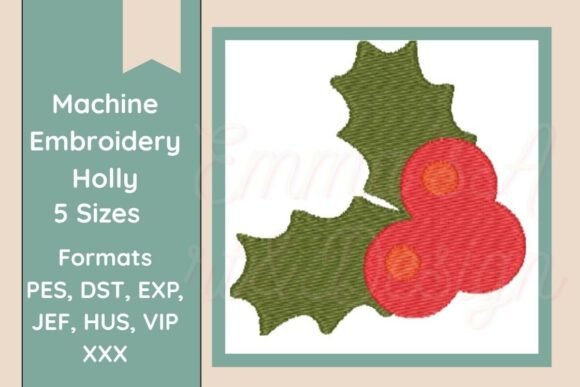
Holly Leaf Machine Embroidery Design
A Festive, Flexible Asset for Small Business Branding
As an embroidery designer who’s developed hundreds of commercial designs for cafés, boutiques, florists, bakeries, and handmade brands, I approach every new machine embroidery design with two questions: “Does it strengthen brand identity?” and “Will it hold up in real-world production?” The Holly Leaf Machine Embroidery Design passes both tests—especially when used intentionally. Its description promises “elegant” and “festive flair,” and that’s exactly what you get: a clean, botanical silhouette with graceful curves, balanced negative space, and seasonal warmth without cliché. It doesn’t scream “Christmas”—it whispers “thoughtful craftsmanship.” That subtlety makes it ideal for small business merch where holiday spirit must coexist with year-round professionalism.
Real-World Performance Across Merchandise Types
This machine embroidery design shines where many holiday motifs fail: versatility. On embroidered patches for staff uniforms, the holly leaf reads clearly at 2.5–3 inches wide—its defined stem and layered leaves avoid visual mush. For apron embroidery at a local bakery or florist, it works beautifully on the chest pocket or corner hem, adding charm without overwhelming. When scaled to 1.75 inches for cap embroidery, the design retains legibility, especially if you simplify inner details during digitizing (a quick pass most experienced digitizers can do). As a tote bag design, it anchors well near the handle seam or centered on the front panel—clean enough to pair with minimalist typography or handwritten brand names.
For boutique merchandise—think ceramic mugs with embroidered sleeve wraps, reusable produce bags, or gift tags—the Holly Leaf Machine Embroidery Design adds tactile sophistication. Unlike dense snowflake or Santa motifs, its moderate stitch density means faster run times, lower thread consumption, and less stress on delicate fabrics like linen-blend totes or organic cotton tees. And because it’s botanical—not character-based—it avoids age or gender limitations, making it equally fitting for a pet wellness brand launching holiday collars or a modern stationery shop offering stitched gift wrap.
Where to Use It Thoughtfully (and Where to Adjust)
Like any strong digital embroidery file, this design demands context-aware execution. Avoid placing it directly on highly curved surfaces—like the front of low-profile caps—without testing first; the leaf’s natural asymmetry may distort if hooping tension isn’t precise. On dark uniforms (navy chef coats, charcoal aprons), confirm your chosen thread colors deliver sufficient contrast—deep forest green on black can disappear without a subtle underlay or white fill base. Also, don’t assume it scales flawlessly below 1.5 inches: tiny veins or tight leaf margins may collapse into a blob. Always test the embroidered patch version at your target size before bulk production.
Fabric texture matters too. On heavily textured weaves (burlap, thick terry cloth), consider simplifying outer outlines or reducing fill density—this isn’t a flaw in the design, but a reminder that even elegant machine embroidery design must respect material behavior. And for items facing frequent washing—staff aprons, café dish towels—verify stabilizer choice: a medium-weight cutaway prevents puckering over time, while lightweight tear-away may shift after five cycles.
How It Shapes Brand Identity and Customer Trust
In small business branding, consistency is credibility. The Holly Leaf Machine Embroidery Design supports that by functioning as a quiet signature—not a loud decoration. When repeated across aprons, tote bags, and packaging accents, it builds visual rhythm without shouting. Customers subconsciously associate that refined leaf motif with care, seasonality, and handmade integrity. That perception lifts perceived product value: a $28 linen tote feels more intentional with this detail than with a generic “Merry Christmas” script.
It also bridges festive and functional. Unlike cartoonish holiday graphics, this design lets your brand remain recognizable in January—especially if you layer it beside your core logo rather than replace it. For Etsy sellers and craft businesses, that duality is gold: it attracts holiday shoppers while reinforcing long-term brand assets. Plus, because it’s elegant—not kitschy—it invites higher engagement on social mockups: customers screenshot, tag friends, and imagine it on their own gear. That organic reach multiplies ROI far beyond the stitch count.
Practical Designer Notes Before You Stitch
- Test in black and white first—assess balance and clarity without color distraction.
- Check small patch viability at your intended size (e.g., 1.75" x 1.5") on actual fabric—don’t rely solely on screen previews.
- Review thread color contrast on both light and dark substrates; request physical thread swatches if ordering custom runs.
- Inspect spacing between leaf elements—tight gaps may cause thread nesting on older machines or dense fabrics.
- Confirm hoop size compatibility with your primary embroidery frames; some versions may require larger hoops than expected.
- Test on real fabric with your standard stabilizer stack—fabric stretch, nap, and weight change everything.
- Create a printable mockup for client approval before digitizing adjustments or production.
- Compare it beside other design assets—does it harmonize with your logo, typography, and existing embroidery files?
- Verify commercial licensing before using on merchandise for resale—this is non-negotiable for small business merch and custom apparel.
The Holly Leaf Machine Embroidery Design isn’t just another Christmas embroidery file. It’s a strategic tool—one that elevates apron embroidery, refines cap embroidery, adds distinction to tote bag design, and quietly reinforces brand identity across every touchpoint. Used with intention, it transforms seasonal stitching into lasting brand equity. Whether you’re a solo craftsperson or a full-service embroidery shop, treat it not as decoration, but as a deliberate part of your design system. That’s how small businesses turn holiday cheer into year-round recognition.