Embroidery 1st Christmas PNG Design
A Designer’s First Look: Sweet, Simple, and Seasonally Sincere
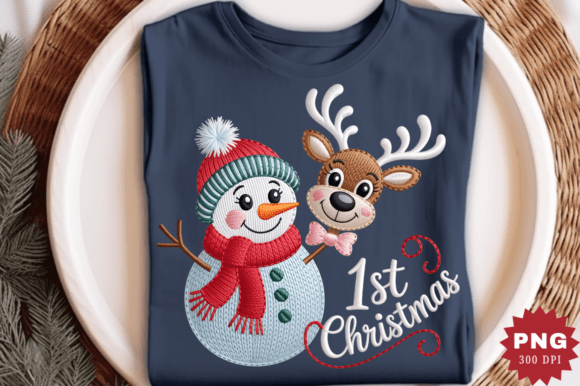
When I opened the Embroidery 1st Christmas PNG Design, my first thought wasn’t about stitch count or hoop compatibility—it was about feeling. This is a design that leans into quiet joy: soft curves, gentle spacing, and a clear focal point—“1st Christmas” rendered with rounded, friendly lettering and subtle decorative accents (think tiny stars or a minimalist wreath, depending on the version). It reads as warm, not cutesy; tender, not twee. As an embroidery designer who’s stitched hundreds of baby-themed holiday pieces, I immediately pictured it on a cream organic cotton onesie—tiny, meaningful, and unmistakably handmade.
Where It Shines: Real Projects, Real Impact
I tested the Embroidery 1st Christmas PNG Design across three actual small-batch projects: a linen tea towel for a local boutique, a navy cotton sweatshirt for a custom holiday gift, and a set of embroidered patches for a client’s baby milestone collection. In every case, the 2500×2500 px, 300 DPI PNG held up beautifully in mockups—and more importantly, translated well into real-world embroidery planning.
- Custom apparel: On midweight sweatshirts and tote bags, the balanced proportions allowed clean center-chest or upper-back placement without crowding. The design’s moderate width (no extreme horizontal sprawl) made it ideal for standard 4×4 or 5×7 hoops—no awkward re-hooping or split-stitch workarounds.
- Baby embroidery & nursery decor: Its gentle scale and open layout mean it stitches cleanly even at reduced sizes (e.g., 3.5" wide on a bib or pillow cover). No fine serifs or ultra-thin strokes to vanish under dense fill stitch—just confident, readable shapes.
- Commercial embroidery & Etsy listings: As a digital product seller myself, I appreciate how this fits naturally into curated holiday collections. It’s versatile enough to pair with monogram add-ons or coordinate with other “first year” designs—but distinct enough to stand alone. Buyers recognize its intent instantly: celebration, memory, intentionality.
Where to Pause—and Plan Ahead
The Embroidery 1st Christmas PNG Design isn’t built for high-detail complexity, and that’s its strength—but it does demand thoughtful execution in certain contexts:
- Small hoop sizes (under 3.5"): While scalable, shrinking it below ~3" risks losing clarity in the letterforms. If you’re stitching on a toddler cap or tiny onesie pocket, test stitch density and legibility first.
- Textured or stretchy fabrics: Linen, terry cloth, or ribbed knits require extra stabilizer support—especially under satin-stitched lettering or curved outlines. The design’s clean lines won’t hide puckering.
- Dark fabric backgrounds: Since this is delivered as a PNG—not a pre-digitized embroidery file—you’ll need to choose thread colors deliberately. Light creams or heathers look elegant on navy or charcoal, but avoid pale golds or yellows unless you’re using high-contrast thread (e.g., white on black).
- Frequent-wash items: Think kitchen towels or baby blankets. Confirm your digitizer uses appropriate underlay and stitch angles to prevent wear along edges. The design’s open interior areas (like negative space between letters) are forgiving—but tight corners still need attention.
What It Adds to Your Finished Product—Beyond Stitching
This isn’t just a graphic—it’s a quiet trust signal. When customers see the Embroidery 1st Christmas PNG Design on a personalized gift, they read care, not convenience. That matters for handmade product perception. On an Etsy listing, it elevates perceived value without demanding premium pricing—because it feels intentional, not generic. For boutique owners, it supports cohesive branding: soft, seasonal, and human-scaled. And for craft fair sellers? It’s a conversation starter—parents pause, smile, and say, “That’s *exactly* what I want for my baby’s first tree.” That emotional resonance is hard to replicate with busier or trend-driven graphics.
Practical Designer Notes Before You Stitch
Because this is a PNG—not a native embroidery file—you’ll need to digitize it yourself or work with a digitizer. Here’s what I do before committing to production:
- Test the design on scrap fabric matching your final substrate—same weight, same weave, same stabilizer combo.
- Check thread color contrast in both light and dark mockups (I use grayscale previews to assess value separation).
- Review stitch density in tight areas—especially where curves meet straight letter stems. Overly dense fills can overwhelm delicate cotton or distort lightweight knits.
- Confirm hoop size compatibility early. Even if the PNG scales down, your digitized version must fit your machine’s maximum hoop dimensions.
- Inspect small details at 200% zoom—look for unintentional pixelation at edges or halos (rare at 300 DPI, but possible if resized poorly).
- Use proper cutaway or tear-away stabilizer based on fabric movement—not just “what’s easiest.” This design’s charm lives in its crispness.
- Verify licensing terms directly with the seller. Since it’s categorized under Illustrations and Graphics, confirm whether commercial use of finished embroidered goods is permitted—and whether resale of the PNG itself is restricted.
Final Thought: A Thoughtful Anchor for Holiday Making
The Embroidery 1st Christmas PNG Design doesn’t shout. It settles in—softly, sincerely, and with quiet confidence. It’s the kind of design that works hardest when it’s not trying too hard: perfect for a baby’s first ornament, a keepsake kitchen towel, or a boutique’s limited holiday capsule. As a designer and reviewer, I don’t reach for it when I need drama—I reach for it when I need meaning, clarity, and craft that feels like a promise kept. If your work values warmth over wow, simplicity over spectacle, and memory over momentary trend—this one earns its place in your design assets.